Art of the Northwest Coast Lowie Museum of Anthropology
The Northward American Collection is the Hearst Museum's largest collection, consisting of more than 500,000 catalogue records, almost 400,000 of which are archaeological. California lone includes nigh 350,000 catalog records.
California
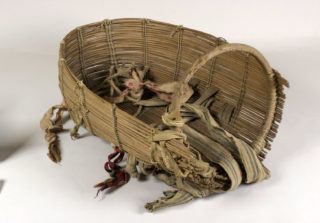
Cradle from Alexander Valley. Cat. No. 1-1
The ethnographic collections ascend from three main sources. The starting time, the California Survey (ca. 1899–1908), represents the about extensive flow of systematic collecting of California ethnology in the Museum's history. Alfred Kroeber was assisted by faculty and students such as Pliny Goddard, Thomas T. Waterman, and Samuel A. Barrett. In most cases, the cultural context of each object was documented in notes, maps, photographs, film, and sound recordings. This survey is an example of what nosotros at present call relieve ethnography, which attempted to preserve Native objects and cognition in museums because white scholars perceived those cultures to be destined for extinction. The population of Native Californians declined precipitously with Spanish, Mexican, Russian, and after American colonization, specially later on statehood due to campaigns of genocide waged by settler colonists. It was in this historical context that the Museum initiated its written report of California tribes primarily in non-urban areas of northern, eastern, and southern California. Recently Native Californians from these and other tribes accept used California Survey materials for their own cultural revitalization projects.
A 2d, much smaller drove was produced past Ishi, a Yahi Indian, during his life at the Museum between 1911 and 1916.
A third collection originated from a smaller 2d California survey (ca. 1925–1935), and a cluster of individual collections, composed mostly of baskets made equally tourist items and sold on the market. This includes the collections of Edwin Fifty. McLeod (1915) and Grace Blair du Pue (1944).
The Museum is peculiarly well known for its collection of more than 8,000 California baskets. Ane of the largest collections in the globe, the collection is especially comprehensive and well-documented. Particularly significant collections come from the Klamath River region (Yurok, Karuk, and Hupa) and the Pomo, too equally an early signed presentation handbasket by Ventureño Chumash weaver Maria Marta Zaputimeu, ca. 1825.

Philip Mills Jones standing on an aboriginal mound, 1901
The University's strength in California archaeology began before the Museum's founding. In 1899, Phoebe Hearst, who would later found the Museum, sent Philip K. Jones to excavate in the Aqueduct Islands and the Central Valley (1899–1902). During the following years, the San Francisco Bay shellmounds were studied, first by Max Uhle (1902), and and so Nels Nelson (1906–1911), Llewellyn L. Loud (1911-1913) and Edward Gifford and W. Egbert Schenck (1924–1925). In 1942, the Sacramento Junior College transferred Jeremiah B. Lillard's collection consisting of his excavations in the Sacramento-San Joaquin River Delta region of Key California.
The Museum's collection of California archeology was enlarged past Berkeley professor Robert F. Heizer and his students during the 1940s and 1950s. Working in what we now phone call a "salvage" archæology model to apace excavate earlier mid-twentieth century dams and road projects destroyed archaeological sites, they formulated a complete regional and temporal reconstruction of the region's earliest inhabitants. The University of California Archaeological Survey collection, numbering 178,000 catalog entries, represents well-nigh two-thirds of the California collection.
The end of the California Survey and the rise of cultural resources management archaeology in the 1970s marked the stop of the Museum's agile interest in field archeology and acquisition of archaeological materials. A few collections undertaken by archaeologists not affiliated with the Museum take been accessioned in recent years, only these undergo rigorous assessment and scrutiny concerning sensitive cultural remains earlier they are brought into the Museum.

Doll fragment. True cat. No. 1-245515
One example is the 13,000 object collection from the San Francisco historic waterfront that were salvaged when the city expanded its sewer lines in 1978. The drove likely represents the most comprehensive "type collection" of celebrated artifacts from nineteenth century San Francisco. Another example of a contempo accession is a collection from the final 1999 earthworks of the Emeryville Shellmound, one of the largest and oldest archaeological sites in the San Francisco Bay Expanse. This accession makes the Museum the sole repository of all the artifacts excavated from this important site for over a century.
Nevada
The archaeological collection from Nevada includes more than than forty,000 catalog records totaling more than 200,000 individual objects. Alfred Kroeber showed an early on interest in the region, which resulted in the exploration of important prehistoric sites such as Lovelock Cave and the Humboldt Lake Basin. In the 1950s and 1960s, Heizer and his students followed Llewellyn Fifty. Loud'due south steps and expanded the Museum's collections to encompass the entire chronological span of the country, from very ancient caves and sites similar the Leonard Rockshelter in Churchill Canton, to contemporary native villages used until the beginning of the 20th century in Lander Canton.
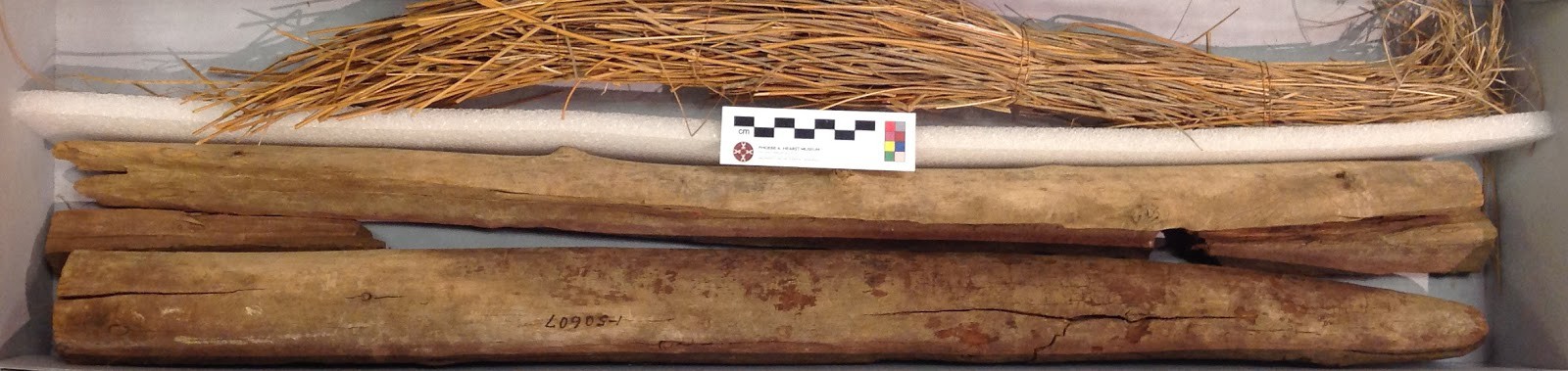
Cottonwood pole from Nevada. True cat. No. 1-50607
Arctic & Pacific Northwest Coast
This area is largely represented by a drove fabricated past the Alaska Commercial Company in the belatedly nineteenth century. In 1897, the University of California was given 2,400 artifacts collected from all 3 culture areas represented in Alaska: the Eskimo of the Arctic, the Athapaskan of the Subarctic, and the Tlingit and Haida of the Northwest Coast. The visitor traders were quite eclectic in their collecting strategy, acquiring trade novelties also equally more traditional items. This accession is complemented by the related drove clustered by Charles Fifty. Hall, an Alaska Commercial Company employee. Kinesthesia curator Nelson Graburn as well donated his well-documented collection of Canadian Inuit soapstone sculpture.
While relatively small, the Northwest Coast collection includes some important Tlingit and Haida objects. Amidst them are a awe-inspiring Haida totem pole and a pair of Kwakwaka'wakw firm posts collected past Charles F. Newcombe; Haida argillite sculpture, including a decorative plate attributed to famed Haida carver Charles Edenshaw; and Tlingit artifacts from early geographer George Davidson.
The Midwest and Southwest United States
The Museum has important holdings from the Southwest United States, with Phoebe Hearst'southward ain donations, especially Pueblo and Navajo textiles, the George Pepper Pueblo pottery collection (1903), Kroeber'south well-documented collection from Zuni (1918), and representative 1930s collections from geology professor Norman E. A. Hinds. From the Plains, there are some of import early collections such equally the Osage and Omaha objects collected by Native anthropologist Francis LaFlesche and Apache and Kiowa objects collected by Ground forces General Hugh L. Scott. Additional objects from this region were collected during Samuel Barrett's filming of the Blackfoot and Sioux Tribes in the 1960s.
Mexico
Mexico was a personal collecting involvement of both Phoebe Hearst and her friend, the anthropologist Zelia Nuttall. Beginning with their efforts, the Hearst Museum possesses the largest museum collection of the finely-woven Saltillo serape blankets in the world. Nuttall also donated some important lacquered items, carved gourds, and textiles. These objects were studied by Katherine D. Jenkins, a student in Berkeley's Decorative Fine art Section. Jenkins went on to amass her ain extensive collection of Mexican folk art, particularly lacquer, during the 1960s and 1970s.

Decorated basin from Teotihuacán. Cat. No. 3-2351
During the belatedly 1950s and early on 1960s, Anthropology professor George M. Foster collected pottery from his primary fieldwork site of Tzintzuntzan, Michoacan. He fabricated a comprehensive representation of Mexican folk art, forth with pottery and other crafts from Jalisco contributed by his graduate students. The Museum'due south strength in Mexican folk art has recently been expanded upon by the acquisition of two large collections, by Steve Vietti and John Paul, with more than 1,400 objects, mostly ceramic figurines representing many aspects of life and beliefs of contemporary rural communities.
Mexican archæology is represented by nearly 30,000 catalog records. Isabel T. Kelly used a large sample of ceramic vessel fragments (9,500 objects) to create her comprehensive pottery typology in 1935. Important collections were donated past William Massey and the geographer Carl O. Sauer (Baja California), Richard Brooks (Chihuahua and Durango), and Edward Westward. Gifford (Sonora and Nayarit).
Decorative & Folk Arts
The Museum also has a significant North American collection from not-Native American peoples. The collection that the Museum inherited from Berkeley'south former Decorative Art & Blueprint Department is particularly strong in textiles, and also contains media. The drove includes 19th-century quilts and coverlets and part of the studio collection of textile designer Dorothy Liebes (ca. 1950–1960s). Highlights from the relatively small only of import drove of American folk art include carving and textiles from African-Americans and New Mexican Hispanics.
Source: https://hearstmuseum.berkeley.edu/collection/north-america/
0 Response to "Art of the Northwest Coast Lowie Museum of Anthropology"
Post a Comment